
The Dietary Guidelines for Americans (DGA) are the U.S. government’s primary nutrition guidance document, updated every five years by the U.S. Departments of Agriculture (USDA) and Health and Human Services (HHS).
The 2025–2030 edition was released on January 7, 2026, and is designed to inform federal nutrition policy, public-facing resources, and the standards used across major programs such as school meals and WIC (Women, Infants, and Children).
Because the DGAs are embedded in procurement, education, and health communication, even subtle changes can influence how clinicians counsel patients, how institutions design menus, and what the public sees as “standard” nutrition advice.
How The 2025–2030 Edition Was Developed
The 2025–2030 DGAs were informed by the Dietary Guidelines Advisory Committee, an independent group of scientific experts tasked with reviewing and synthesizing the evidence base and providing advice to HHS and USDA. The Committee’s Scientific Report is a key input to the final DGAs, but it is not itself a draft of the policy document; additional inputs can be considered during the finalization process.
Harvard T.H. Chan School of Public Health reported that three of its faculty members served on the Advisory Committee: Teresa Fung, Edward Giovannucci, and Deirdre Tobias. The same report notes that an additional panel was appointed to review the Committee’s report, underscoring how the final DGAs can reflect both scientific review and broader policy decisions.
Core Messages That Remain Familiar
Despite high public attention on what is “new,” several foundational elements largely track prior federal guidance. Faculty members who served on the Advisory Committee described continuity in quantitative recommendations for core food groups, including fruits, vegetables, whole grains, dairy, and oils, alongside longstanding limits for saturated fat and added sugars and continued emphasis on whole foods.
This continuity matters clinically: it reinforces the central role of dietary patterns rather than single nutrients in shaping long-term cardiometabolic and overall health outcomes.
Notable Shifts In Emphasis
The 2025–2030 DGAs are presented with the overarching message “eat real food,” and they place heightened attention on reducing highly processed foods and added sugars.
At the same time, the new edition elevates protein more explicitly than recent iterations, including a stated protein “serving goal” of 1.2–1.6 grams per kilogram of body weight per day (with adjustment based on caloric needs).
In the same document, dairy is framed as a central category, with “dairy serving goals” described as three servings per day within a 2,000-calorie pattern.
These quantitative targets are among the most discussed elements of the update because they signal a clearer prioritization of protein foods and dairy within the overall dietary pattern.
A New Visual Approach And The Return Of The Pyramid
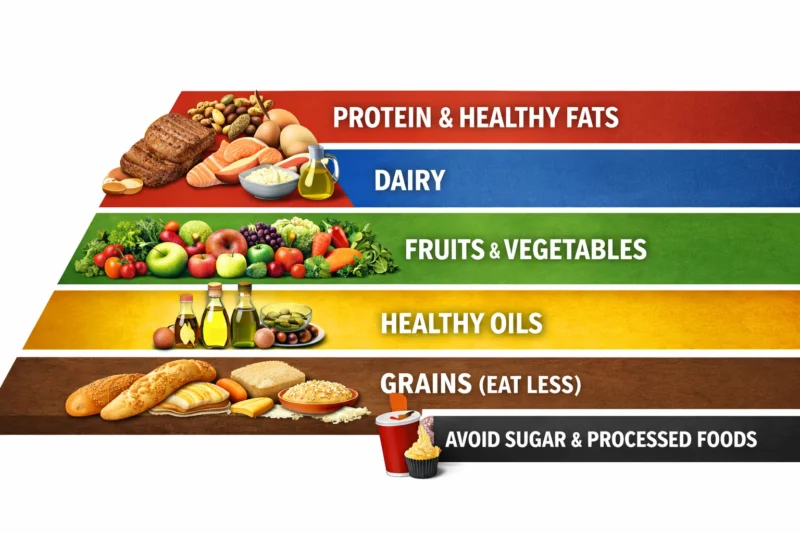
The DGAs also mark a visible communications shift. The federal government moved away from the classic Food Guide Pyramid in the 2000s and replaced it with MyPlate in 2011, an icon intended to simplify healthy-meal composition.
The 2025–2030 edition reintroduces a pyramid-style visual and frames this as a renewed public-facing guide, reflecting a more consumer-oriented format than the longer policy documents of prior cycles.
From a public health standpoint, the communication challenge is not only what advice is given, but how it is interpreted. A shorter, more visual framework may increase reach, but it can also compress nuance that clinicians and nutrition professionals rely on when counseling individuals with complex medical needs.
Alcohol And Added Sugar: Clearer Tone, Different Framing
Two areas stand out for their messaging approach: alcohol and added sugar.
On alcohol, reporting on the January 7, 2026 release highlighted a departure from prior numeric “moderate drinking” thresholds, shifting instead toward a general recommendation to “consume less alcohol” for better health.
This change has drawn attention because alcohol guidance is closely watched by clinicians and public health groups, particularly given the broader evidence base linking alcohol to multiple health risks.
On added sugar, the new DGAs adopt a more forceful tone about avoidance of added sugars and sugar-sweetened beverages, and include specific quantitative framing such as a per-meal added sugar cap in the document.
Scientific Debate And Expert Concerns
Even where the DGAs maintain certain numeric caps such as keeping saturated fat under 10% of daily calories the practical feasibility of meeting those caps depends on the recommended food pattern.
In Harvard’s discussion with Advisory Committee members, Deirdre Tobias and Teresa Fung described concerns that the final DGAs prioritize animal sources within the protein group and promote full-fat dairy in ways that may diverge from the Committee’s scientific framing.
They also noted concerns about how fats are communicated, including the relative visibility of vegetable oils as sources of essential unsaturated fats.
External stakeholders have also weighed in. The American Heart Association, for example, welcomed efforts to reduce added sugars and sodium while urging caution about high-fat animal products and encouraging emphasis on plant-based proteins, seafood, and lean meats pending further research.
Relevance For Cancer Prevention And Survivorship Nutrition
For oncology audiences, the DGAs matter less as a rigid set of rules and more as a signal of what will shape U.S. food environments and counseling norms. Major cancer-focused organizations continue to emphasize overall healthy dietary patterns that prioritize vegetables, fruits, and whole grains while limiting red and processed meats, sugar-sweetened beverages, and highly processed foods.
Alcohol messaging is also clinically salient in cancer prevention discussions. While individual risk varies, leading health authorities have emphasized that alcohol can increase health risks, including certain cancers making clarity and precision in public guidance consequential for prevention-oriented counseling.
For patients in active treatment or survivorship, individualized nutrition needs can differ substantially based on diagnosis, therapy, symptoms, and comorbidities. As a result, broad federal guidance should be interpreted as a population-level framework rather than a substitute for dietitian-led, patient-specific care.
Practical Interpretation For Clinicians And The Public
The most clinically useful way to read the 2025–2030 DGAs is to separate three layers of guidance. First is the shared core: prioritizing minimally processed foods and improving dietary quality.
Second are the measurable targets such as protein and dairy goals that may not fit all individuals and may require clinical context. Third is the real-world food environment: what schools, hospitals, and assistance programs can realistically implement at scale.
Advisory Committee members also highlighted the importance of supplementary tools for the public, including plate-based resources and consultation with registered dietitians when more individualized guidance is needed.
More posts about Public Health on OncoDaily
Written by Nare Hovhannisyan, MD